Visualizing the sounds of evolving tattoo machines
Tattooing is a widespread and ancient human practice. It exists in cultures on every inhabited continent, and there is archaeological evidence that many of these tattoo practices have existed for thousands of years or longer.
Evolving tattoo technologies
The technology used to produce tattoos is far from static, with tools and methods evolving over time and across space. Every tattoo culture, from Māori tā moko to today’s professional studios in urban cities, uses a different set of practices or techniques.
If you walk into a professional studio in New York or London or Sydney, you’ll usually receive a tattoo from an artist using an electric machine. Electric tattoo machines fall into one of two main types: coil and rotary. From Wikipedia:
- “Coil tattoo machines function by passing current through two coils which alternate electromagnetic forces to move the tattoo needle up and down rapidly.”
- “Rotary tattoo machines function by using the rotational motion of an electric motor to move a needle/bundle of tattoo needles up and down rapidly.”
Coil machines were the foundation of the modern tattoo industry throughout most of the 20th century. Rotary machines have been widely adopted over the past few decades. From memory, I’m pretty sure that all of my tattoos were produced with rotary machines. Recently, rotary machines have been adapted into a pen shape for better ergonomics, and these pen guns are often fully wireless with an internal power source. Tattoo artists often call pen guns “dildo guns”, either as a humorous term or a perjorative term, which I think is great.
Many tattoo artists, particularly the older artists who are still active today, have expressed an anxiety that with the widespread adoption of rotary machines, coil machines will become permanently a thing of the past. Coil machines make a signature “buzz” noise, which permeated the soundscape of tattoo studios throughout much of the 20th century, and there is a fear or sadness that this intangible link to tattooing’s past will be lost or forgotten by the modern tattoo community.
Electric machines co-exist along with many non-electric technologies. Many artists build a significant client base and Instagram following for their hand-poke tattoos. Of course, everyone had to tattoo by hand before the recent invention of electric tattoo machines in 1891.
The sound of tattoo
I downloaded sound recordings of 3 types of electric tattoo technology: rotary machine, coil machine, pen coil machine (dildo gun). I also obtained sound recordings from two particular hand tattoo practices: Philippines hand tapping (mambabatok) and Japanese hand-poke (tebori).
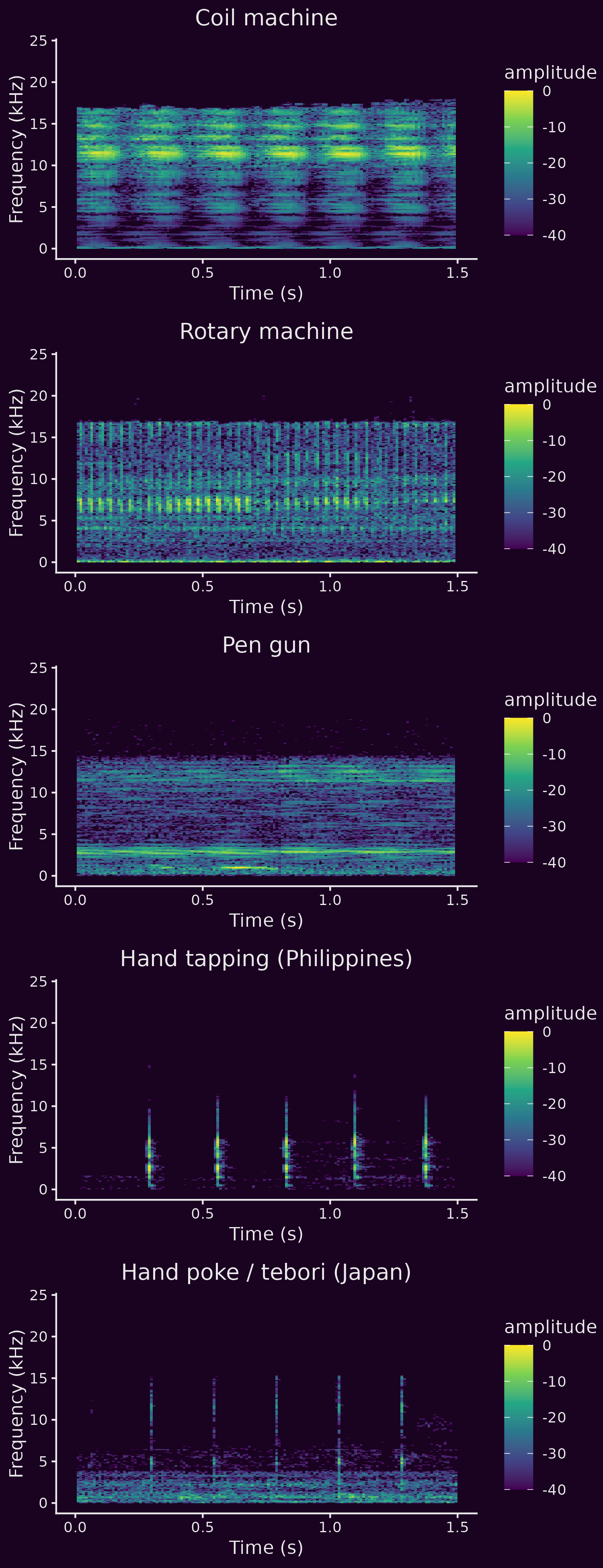
Below are the spectrogram of these 5 tattoo technologies.
Looking at the coil machine, you can clearly see the loud, high-frequency buzzing sound. The sound of the rotary machine is lower in both frequency and amplitude — this visual comparison encapsulates the loss of the classic coil machine sound. The high-end pen gun is even quieter and deeper still.
The Philippines hand tapping shows bright, low-frequency clunks corresponding to the artist Whang-od tapping the tattoo needle with wood. There is a similar, but quieter, series of taps for the Japanese tebori hand-poking.
You can listen to these particular sounds on Youtube:
- This sound in a few years time will be unrecognizable, the buzzing sound of an coil tattoo machine
- Jackhammer Rotary Tattoo Machine Demo
- Ambition Mars-U 2.2-4.2mm Adjustable Stroke Wireless Tattoo Machine #ambition #tattoomachine #artist
- The Whang Od tattoo experience. Getting a mambabatok, from the world’s oldest tattoo artist 107yrs
- ASMR Tebori Tattoo by horimasa #asmr