Mental health and premenstrual/period symptoms in transgender women
Content warning: This article mentions depression, mental illness, mental health, suicidal ideation, and bias against women. There are also swear words.
Here is a graph of my depression over the past month or so. The score is the depression subscale from the Depression, Anxiety and Stress Scale (DASS-21), detailed here. Higher numbers correspond to higher depression. A score 21+ indicates severe depression, and a score 28+ indicates extremely severe depression.
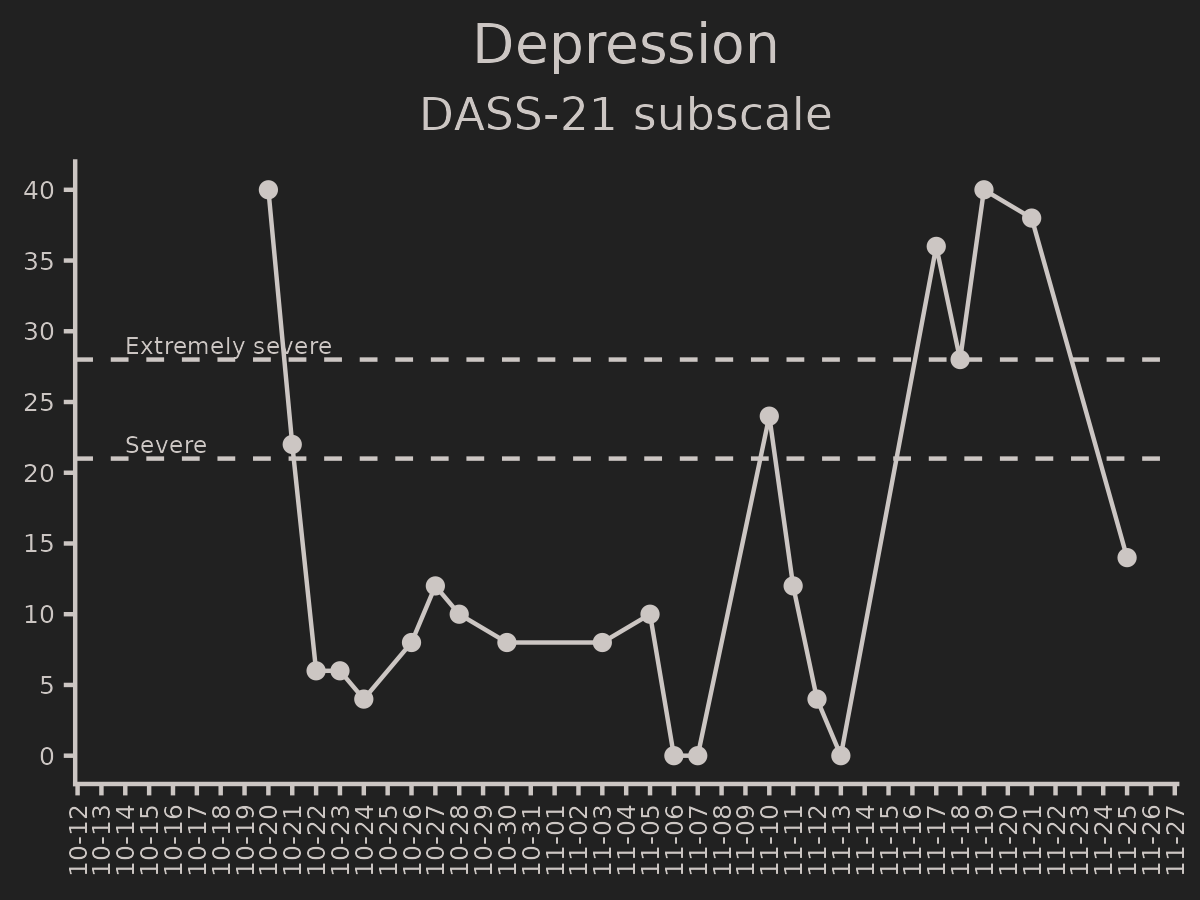
Here’s the interesting thing: there was a clear peak in depression on 20 Oct (in fact, I began recording my mood that day precisely because I was experiencing such intense depression). But there was also a clear peak one month later.
I didn’t track my mood before October. However, I do keep a journal. Here are some journal entries from approximately the same time of the month:
- 2025-09-21: “panic attack, help”
- 2025-08-14: “slept badly, suicidey”
- 2025-07-16: “very fucking stressed about the amount of goddamned crap […] sick of sirens, sick of noise, sick of people always being fucking on top of me”
- 2025-06-15: “ok still a bit of [gender] dysphoria, some suicideyness today”
- 2025-05-14: “tired, cold, sleepy, a bit anxious (as a manifestation of tiredness). oof.”
- 2025-04-14: “i want to die”
- 2025-03-14: “feeling anxious and difficulty focusing”
- 2025-02-19: “grumpy grumpy grumpy. why am i so pissed off?”
- 2025-01-18: “crisis”
So, there is definitely a pattern in which I experience decreased mental health between the 14th and 21st of the month, every single month.
Note that there is no control group. I could statistically analyze my journal to formally test for a difference in frequency of mental illness-related words between the 14th and 21st of each month, relative to the other days of each month. Without a formal statistical comparison, it’s possible that the above pattern can be better explained as follows: my mental health varies mostly randomly, and if you look for a pattern with a certain level of uncertainty (e.g., a fairly wide window of days), you are bound to find a pattern even where there is only random variation. This is similar to the statistical phenomenon of alignment of random points, which can explain the otherwise spooky tendency for famous landmarks to be aligned in space.
So, we have found a pattern, and this pattern offers an interesting hypothesis. But we can’t say for sure that the cause is a monthly cycle in mood without conducting further statistical test.
Of course, cisgender women around the world are no stranger to a monthly mood cycle — premenstrual syndrome. But I’m not a cisgender woman; I’m a transgender woman. I don’t have a “natural”, biological menstrual cycle.
I asked about this in an online trans community. Several trans women in this community (who, like me, take estrogen as part of feminizing hormone replacement therapy) indeed reported that they experience monthly cycles in their mood. This is anecdotal evidence, not statistical data — there are other patterns related to menstruation that heaps of women will claim definitely exist but that can be better explained by random chance or cognitive bias (e.g., menstrual synchrony).
There is very little published evidence on the phenomenon of prementrual/period experiences in trans women, with one notable exception being the excellent 2024 thesis by Rin Nguyen (link). This is unsurprising, given the limited volume of research that addresses mental health issues affecting cisgender women.
Nevertheless, this is a very interesting phenomenon. Could trans women really experience monthly cycles in their moods? If so, this would obviously open up some powerful avenues for improving the mental health of transgender women.